








How to Bet on College Football
Betting College Football can be overwhelming but BetQL makes it easy
 Brian Hunt - Aug 11, 2026, 6:07am EDT
Betting Against The Spread In College Football
College Football Odds can be broken down into a few different sections, including College Football Point Spreads, College Football Money Lines, College Football Totals, College Football Over/Unders, College Football First Half Odds, and College Football 2nd Half Odds. How to read college football betting odds can be confusing, especially for new bettors, but BetQL is here to help with this college football betting guide. Whether you're learning how to bet on college football for the first time or looking for better ways to analyze the market, understanding each type of wager is essential. Be sure to check back on BetQL every week for all our latest College Football Predictions.
College Football Spreads
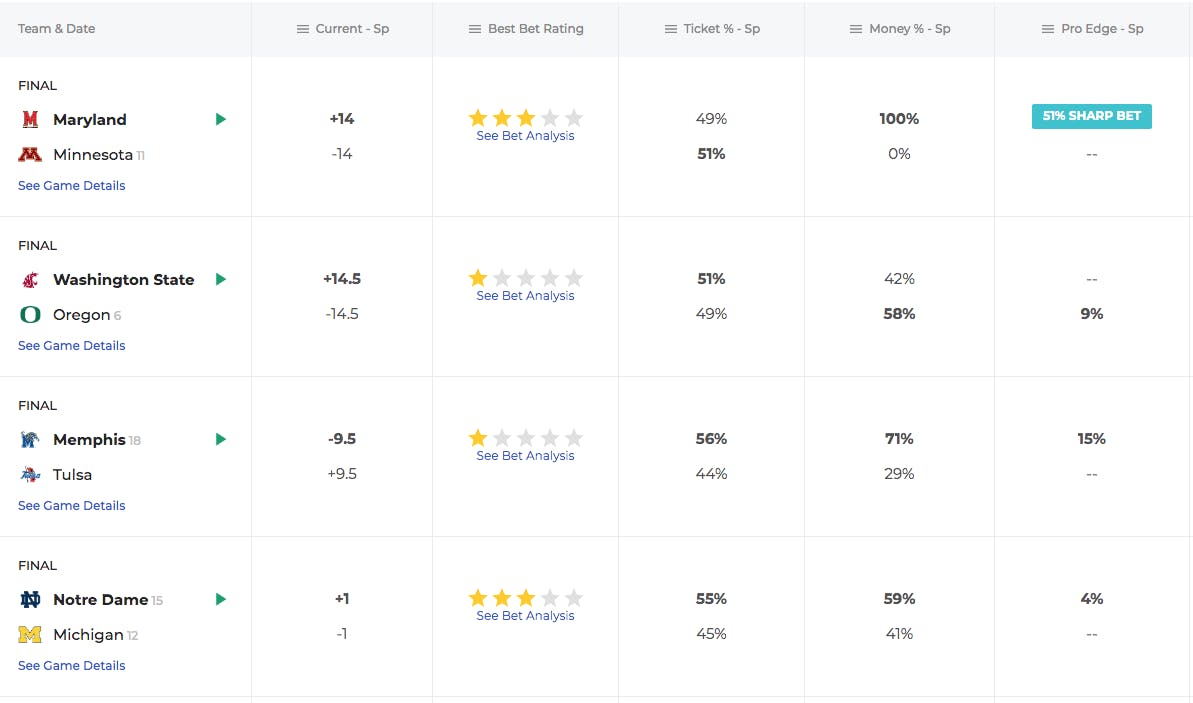
Betting against the spread, or ATS for short, is one of the most popular ways to bet on football and is a key part of college football betting tips and strategies. The team that is favored will be listed with a negative number (i.e. -5), and that is the number they need to win the game by. In this example, the favorite must win by 6 or more points to “cover” the spread and win the bet. If they win by exactly 5 points, the bet is considered a “push” or “no-bet.”
The inverse of this college football betting line example is called the underdog. Next to their team will be a positive number (i.e. +5), and this number is the maximum their team can lose by. In this example, the underdog can lose by 5 points or less to be considered a win. If the team loses by exactly 5, then the bet is considered a “push” or “no-bet.”
Understanding how to bet college football spreads starts with knowing how the point spread and odds work together. The corresponding college football spread will include a number that shows the odds of what your bet will pay out. We will use the same example we used to show how college football point spreads work, but now add in the college football betting odds:
Alabama (-5) -110
Clemson (+5) -110
The -110 in the example above represents the college football betting odds. This shows that you would need to bet $110 to win $100. The sportsbook sets the odds this way to encourage betting on both sides of the college football line. The sportsbook will also take a portion of the bet, which is known as the “vig” or “juice.” Essentially, this is like a tax you pay for the opportunity to place the bet.
When betting against the spread, many sportsbooks will allow you to “buy points,” which changes the line at adjusted odds. For example, Alabama may be a -5 favorite over Clemson in the National Championship at -110 odds, meaning a $110 bet on Alabama would pay out $100.
You really like Alabama to win the game but are worried that Clemson will keep the game close.
In this case, you could buy a half point, moving the line to Alabama -4.5 and making Alabama cover the spread if they win by 5 points instead of pushing with the original line. However, if you decide to do this, the odds for the new Alabama line may move to -130, reducing your potential payout. Buying points is not available at all sportsbooks.
Betting against the spread in college football can be tricky, and you must find value in your college football spreads in order to remain profitable over the long term. For bettors learning how to bet on college football for beginners, understanding the relationship between the spread, odds, and potential payout is an important first step.
Betting College Football Moneylines
College Football Moneyline betting is one of the simplest and most popular forms of betting. In college football moneyline betting, you are simply picking which team will win the game outright. College football moneyline betting explained is relatively straightforward: the favorite in a given game is listed as a negative number (i.e. -200), which means you will have to bet that amount to win $100. The underdog is listed as a positive number (i.e. +500), which means you will win that amount on a $100 bet.
A bet can “push” in college football moneyline bets if the game ends in a tie. In this case, most sportsbooks will return the amount that was wagered on the game.
The lines in college football moneyline betting typically range from -110, which would be considered a small favorite, all the way up to -1000, which would be considered a massive favorite. You can head over to our college football odds page, which shows some of our best value bets for the day, to see if the action is worth it.
An example of a college football game that would likely have tight moneyline odds would be a game between Alabama and LSU played in LSU. In this case, Alabama would likely only be -120 favorites or could even be a “pick 'em” game where both teams have -110 odds.
A game that would have larger moneyline odds would be a game between Alabama and Arkansas played in Alabama. In this case, Alabama could be -800 or higher as a moneyline favorite.
College football moneyline bets can be difficult when you're trying to find value, and that is why college football moneyline betting is not as popular as betting against the spread or betting a college football over/under. Many bettors like to parlay multiple moneyline bets together to help improve the potential payout.
BetQL can help you make more informed college football moneyline bets because we provide updated college football moneylines. We work closely with sportsbooks to show you the latest available data.
Betting College Football Totals
College football totals betting is wagering on the combined points scored by both teams in a selected game. There are also options to bet on how many points only one of the teams will score. More commonly, this type of bet is called an over/under bet.
When learning college football over under betting, you'll typically see totals between 40 and 80 points. Similar to betting the spread, there can be a “push” if the total number of points scored in the game exactly equals the total. You can also bet on the total points scored in the first half, otherwise known as college football first-half over/unders.
Once the first half of a game is over, you can also bet on the total points scored in only the second half of a college football game, which is referred to as college football second-half over/unders.
When betting college football over/unders, many sportsbooks will allow you to “buy points,” which will change the total at adjusted odds. For example, an Alabama-Clemson matchup may have an over/under of 65 points. You really like Alabama to score a lot of points but may not like Clemson to score as many as projected. In this case, you could “buy” a point to adjust the total. However, the odds would also adjust, potentially reducing your payout.
Understanding college football betting odds explained through spreads, moneylines, and totals can help bettors compare different wagering options and determine which markets best fit their strategy.
First Half Betting Against the Spread
Betting the college football first-half moneyline is almost as easy as it sounds. You are simply picking which team will win the first half of a college football game. The first-half favorite will be listed as a negative number (i.e. -300), which means you will have to wager $300 to win $100. The underdog will be listed as a positive number (i.e. +400), which means you will win that amount on a $100 bet.
College football first-half moneyline bets are essentially the same as full-game college football moneyline bets except that they only apply to the first half. This means that any result in the second half does not count toward the bet.
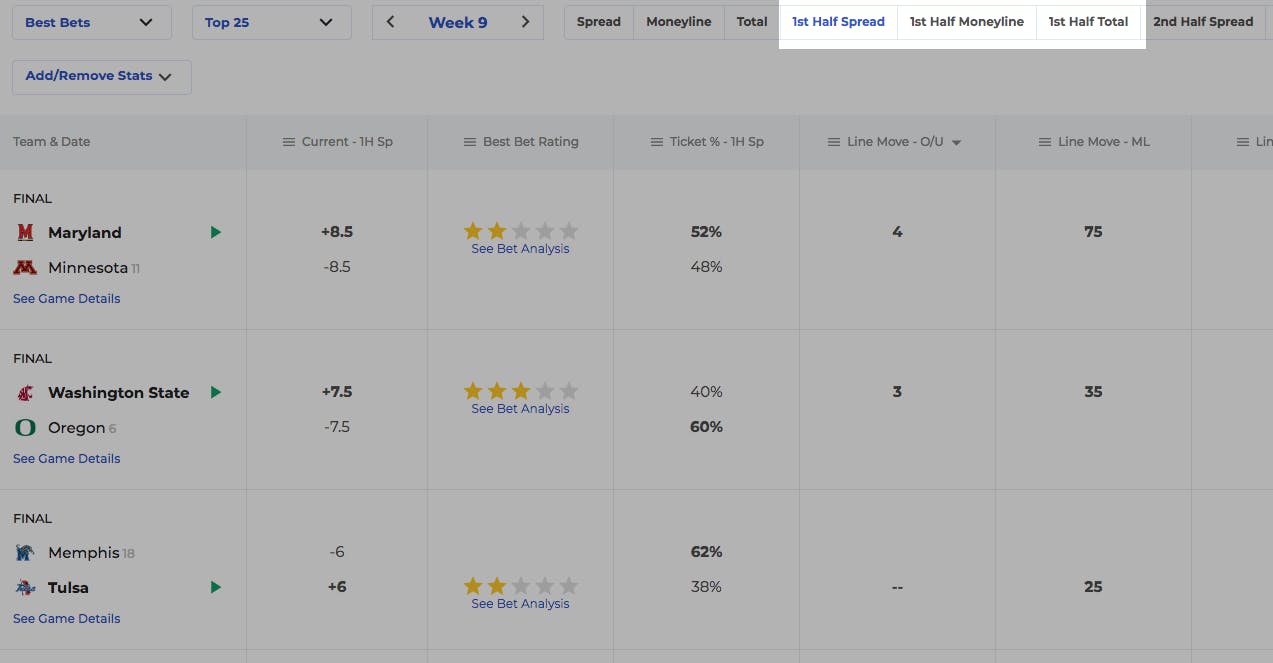
Betting college football first-half spreads is the same concept as betting college football first-half moneylines, except you are betting against the spread (ATS). College football first-half moneylines are typically at lower odds than full-game college football moneylines.
This makes college football first-half moneyline betting popular among bettors who like to target teams that are big favorites in a given matchup. Underdogs should not be overlooked in college football first-half moneyline betting, especially home underdogs that tend to come out and play well in front of their home fans before talent and ability take hold in the second half.
College football first-half moneyline bets can be ideal for teams that have a trend of getting off to a hot start or have better odds on a first-half-only moneyline bet. One of the hardest parts of betting a college football first half is that the odds are constantly being updated. Most sites aren't able to show you the most updated first-half spreads, but at BetQL we can.
We work closely with sportsbooks to provide you with updated college football first-half odds, lines, and spreads.
First Half Moneyline Betting
Betting college football first-half moneyline is almost as easy as it sounds. You are simply picking which team will win the first half of a college football game. The first-half favorite will be listed as a negative number (i.e. -300), which means you will have to wager $300 to win $100. The underdog will be listed as a positive number (i.e. +400), which means you will win that amount on a $100 bet.
College football first-half moneyline bets are the same as full-game college football moneyline bets except that they only apply to the first half. This means that any result in the second half does not count toward the bet.
Betting college football first-half spreads is the same concept as betting college football first-half moneylines, except you are betting against the spread (ATS). College football first-half moneylines are typically at lower odds than full-game college football moneylines.
This makes college football first-half moneyline betting popular among bettors who like to target teams that are big favorites in any given matchup. Underdogs should not be overlooked in college football first-half moneyline betting, especially home underdogs who tend to come out and play well in front of their home fans before talent and ability take hold in the second half.
College football first-half moneyline bets are ideal for teams that have a trend of getting off to a hot start or have better odds on a first-half-only moneyline bet. One of the hardest parts of betting college football first half is that the odds are constantly being updated.
Most sites aren't able to show you the most updated first-half spreads, but at BetQL we can. We work closely with sportsbooks to provide you with the most updated college football first-half odds, lines, and spreads.
Betting 2nd Half Spread in College Football
Betting college football second-half moneyline is exactly what it seems. You are simply picking which team will win the game in the second half. The score from the first half has no impact because betting the second-half moneyline only takes into account the score from the second half.
When you are looking at the moneyline for the second half of a college football game, the favorite will be listed as a negative number (i.e. -300), which means you will have to bet that amount to win $100. The underdog for the second half will be listed as a positive number (i.e. +300), which means you will win that amount on a $100 bet.
College football second-half moneyline bets are the same as a full-game college football moneyline bet except that they only apply to the second half. Again, this means that any results from the first half do not count toward the bet.
College football second-half moneyline bets are ideal for teams that have a trend of getting behind early but making comebacks. Second-half moneyline bets can also be useful when a large favorite gets behind in the first half against an underdog.
There are also options to bet college football first-half spreads. Betting college football first-half spreads is the same concept as betting college football first-half moneylines, except you are betting against the spread (ATS).
College football second-half moneylines are typically at lower odds than full-game college football moneylines. However, second-half moneylines are adjusted based on a combination of the first-half results and the lines for the whole game.
This makes college football second-half moneyline betting popular among bettors who like to target teams that are big favorites in any given matchup and might be down at halftime. Underdogs should not be overlooked in college football second-half moneyline betting, especially home underdogs who may be down after halftime but have a good chance for a second-half comeback.
There are also options to bet on college football second-half totals, as well as college football second-half team totals. These bets focus on how many total points will be scored by both teams in the second half or, in the case of college football second-half team totals, the amount of points scored by only one of the teams.
Betting 2nd Half Moneylines in College Football
Betting the college football second-half moneyline is exactly what it seems. You are simply picking which team will win the game in the second half. The score from the first half has no impact because betting the second-half moneyline only takes into account the score from the second half.
When you are looking at the moneyline for the second half of a college football game, the favorite will be listed as a negative number (i.e. -300), which means you will have to bet that amount to win $100. The underdog for the second half will be listed as a positive number (i.e. +300), which means you will win that amount on a $100 bet.
College football second-half moneyline bets are the same as a full-game college football moneyline bet except that they only apply to the second half. Again, this means that any results from the first half do not count toward the bet.
College football second-half moneyline bets are ideal for teams that have a trend of getting behind early but making comebacks. Second-half moneyline bets are also good when a large favorite gets behind in the first half to an underdog.
There are also options to bet college football first-half spreads. Betting college football first-half spreads is the same concept as betting college football first-half moneylines, except you are betting against the spread (ATS).
College football second-half moneylines are typically at lower odds than full-game college football moneylines. However, the second-half moneylines are adjusted based on a combination of the results from the first half and the lines for the whole game.
This makes college football second-half moneyline betting popular among bettors who like to target teams that are big favorites in any given matchup and might be down at halftime. Underdogs should not be overlooked in college football second-half moneyline betting, especially home underdogs who may be down after halftime but have a good chance for a second-half comeback.
Stories you might also like
See All![[object Object]](https://images.prismic.io/betql-staging/7VTkiTaXyBLm2pY4_DK_OSB_NFL_Launch-NCOGenericPlayer_TP_1200x628_Spend5Get200_SyntheticPlayer.png?auto=format%2Ccompress&w=280&h=200&fit=crop)
![[object Object]](https://images.prismic.io/betql-staging/5d_DlhNuO-6lbiJ-_NCAAF_MULTI_SPREAD.png?auto=format%2Ccompress&w=280&h=200&fit=crop)
![[object Object]](https://images.prismic.io/betql-staging/aTfhlHNYClf9n9Oq_General-LibraryBG-text-7-.png?auto=format%2Ccompress&w=280&h=200&fit=crop)
![[object Object]](https://images.prismic.io/betql-staging/aIoVQlGsbswqTeon_ChatGPTImageJul30%2C2025%2C02_50_50PM.png?auto=format%2Ccompress&w=280&h=200&fit=crop)
![[object Object]](https://images.prismic.io/betql-staging/w7zIrD2U-kYKE7Om_NCAAFMoneyline.png?auto=format%2Ccompress&w=280&h=200&fit=crop)
![[object Object]](https://images.prismic.io/betql-staging/aIn4o1GsbswqTeSU_ChatGPTImageJul30%2C2025%2C12_48_28PM.png?auto=format%2Ccompress&w=280&h=200&fit=crop)
![[object Object]](https://images.prismic.io/betql-staging/aKQn-6Tt2nPbaciM_ChatGPTImageAug19%2C2025%2C09_29_37AM.png?auto=format%2Ccompress&w=280&h=200&fit=crop)
![[object Object]](https://images.prismic.io/betql-staging/aNFAC55xUNkB0-I2_NCAAFWEEKLY.png?auto=format%2Ccompress&w=280&h=200&fit=crop)